Download
Abstract
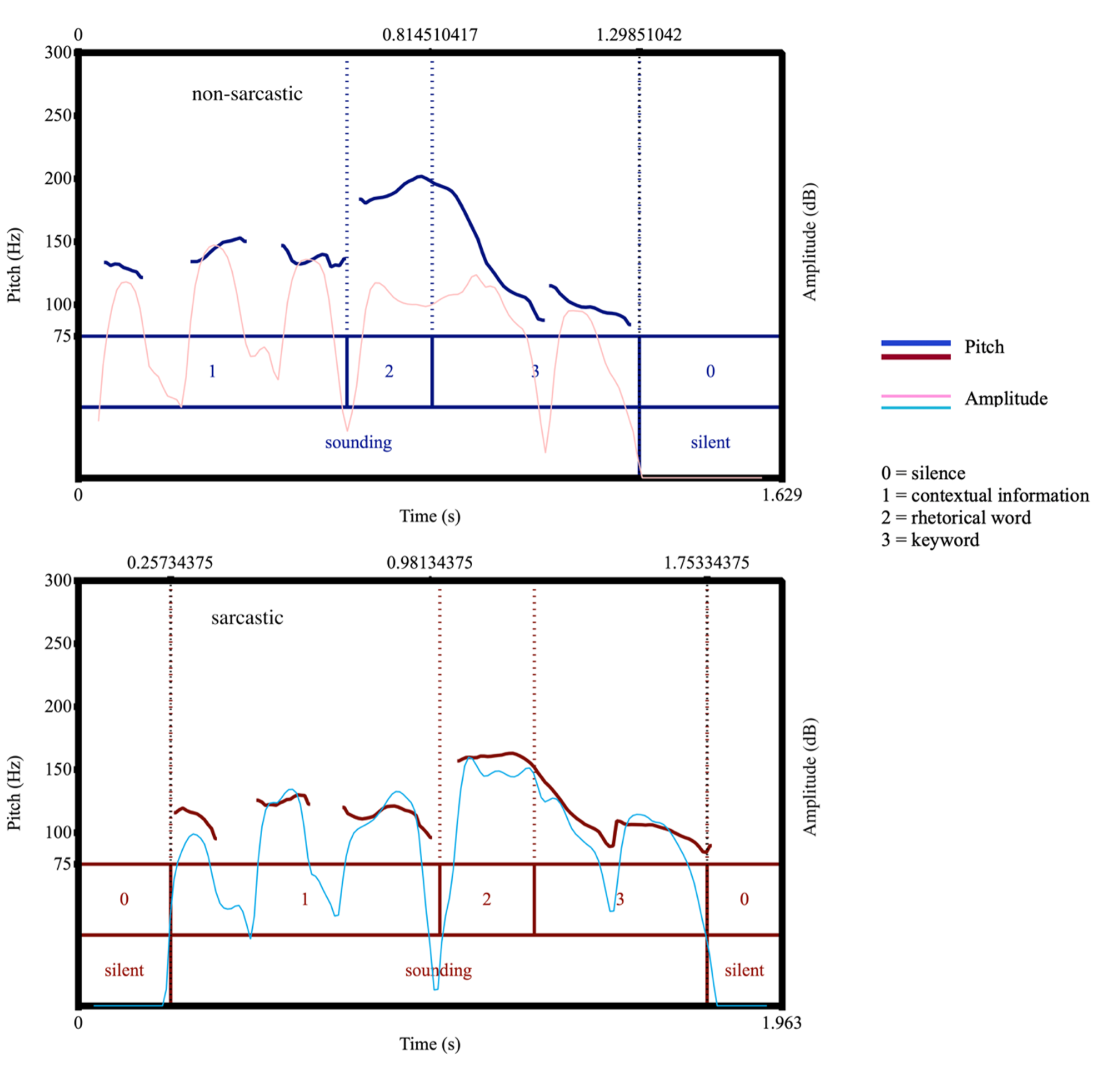
The prosodic realization of sarcasm, a subtype of irony, has not received much research attention heretofore. While prior studies on the prosody of sarcasm in English, Cantonese, etc. support that the prosodic patterns of sarcasm are unique to different languages, there is still a paucity of literature on the prosody of sarcasm in Mandarin Chinese. Different conversation scenarios were designed in the current study to elicit sarcastic and non-sarcastic recordings from native speakers of Mandarin Chinese. The degree of sarcasm of these recordings were then validated in a rating task. The acoustic analysis of the sarcastic recordings showed that globally, lower pitch, lower amplitude, lower speech rate, and greater amplitude range characterized sarcasm, which is consistent with the discoveries of Li (2020), a prior study on sarcasm in Mandarin Chinese. Despite such consistency, the study also noticed prosodic characteristics that were not attended to previously. For one thing, locally, the rhetorical word and the sarcastic keyword were marked with lower pitch values and lower speech rate. For another, the study also inspected the effect of two lexical patterns that are commonly used as sarcastic markers, “degree adverb + positive adjective” and “positive noun with high intensity”. The prosodies of sarcasm constructed of these two lexical patterns differed from each other. A lift in amplitude range was found in sentences following the latter pattern, denoting the possible independence of hyperbolic sarcasm from conventional sarcasm.
Figure 9. F0, amplitude, and duration of the sentence “你學習真用功” by a female speaker
Citation
Zhou, W., & Zou, T. (2021, July 19). The prosody of sarcasm and its relationship with lexical choices in Mandarin Chinese [Oral presentation]. The 14th Phonetic Conference of China (PCC2021), July 18-20, Lanzhou, China.